Eat Sleep Game Repeat Sublimation PNG: A Practical Guide to Its Use and Alternatives
For gamers and crafters alike, the phrase “Eat Sleep Game Repeat” has become a playful mantra that captures a lifestyle. Turning this into a sublimation PNG file opens up many creative possibilities—from custom T-shirts to mugs, stickers, and home decor. But before you choose a digital file format for your next project, it helps to understand what a sublimation PNG like this one actually offers, how it compares with other file types, and when it is the best fit for your needs. This guide walks through those considerations so you can make a confident decision.
What Is an Eat Sleep Game Repeat Sublimation PNG?
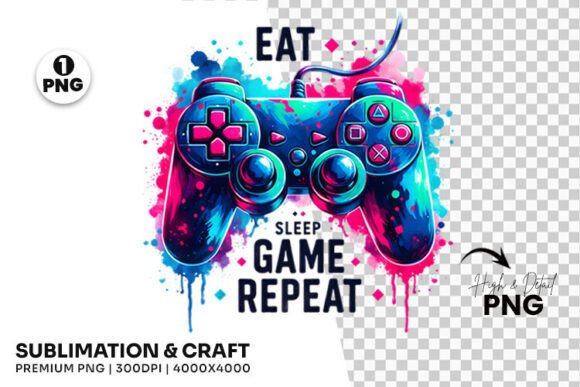
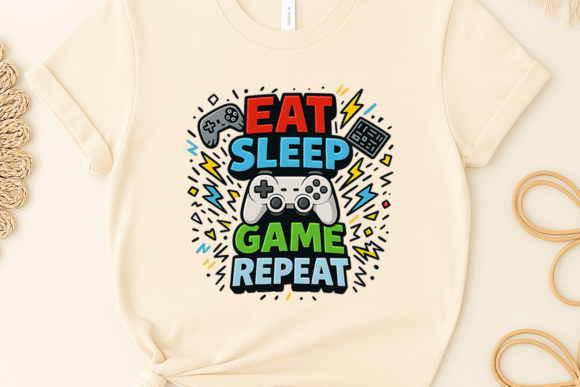
A sublimation PNG file is a digital image with a transparent background, designed specifically for sublimation printing. The “Eat Sleep Game Repeat” version typically features bold, stylized text and sometimes gamer-themed elements like controllers, keyboards, or pixel art accents. Because it is saved in PNG format, the background is invisible, allowing the design to be placed directly onto substrates like polyester fabrics, coated mugs, or ceramic tiles without white halos or unwanted backing.
What makes this particular PNG distinct is its ready-to-use nature. The file comes in high resolution—often 300 DPI or higher—so the text remains crisp when scaled to standard print sizes. The transparency is already handled, which means you do not need to remove a background yourself. For a crafter who wants to produce a quick batch of T-shirts or a set of gamer-themed items, this format removes one of the most time-consuming steps: preparing the artwork.
How It Compares With Common Alternatives
While the Eat Sleep Game Repeat Sublimation PNG is convenient, it is not the only digital format available for similar projects. Understanding the differences can help you match the file type to your workflow.
PNG vs. JPEG for Sublimation
A JPEG version of the same design would have a solid white background, making it unsuitable for direct sublimation unless you manually isolate the design. The PNG eliminates that extra step. However, JPEGs sometimes offer smaller file sizes, which can matter if you are storing many designs. For most print projects, the PNG’s transparency and edge quality outweigh the slight size savings.
PNG vs. SVG (Scalable Vector Graphics)
SVG files are vectors, meaning they can be scaled to any size without losing sharpness. If you plan to enlarge the design for a large wall decal or a full-back T-shirt print, an SVG will be mathematically perfect at any dimension. The PNG, being a raster image, will eventually show pixelation if enlarged beyond its native resolution. However, the creator usually supplies the PNG at a high enough resolution that it handles typical T-shirt sizes (up to perhaps 16 inches wide) very well. The tradeoff is that SVGs often require more advanced software (like Adobe Illustrator or a vector editor) and may need font embedding or outline conversion. The PNG is simpler—open it in any image viewer, load it into your sublimation software, and print.
PNG vs. Layered PSD or TIFF
Layered files give you control over individual elements—you could change the color of the text, swap out a game controller icon, or adjust the spacing. A PNG is flattened: you get the exact design as provided. If you like to customize every detail, a layered file is better. But if you want something that is already polished and ready to go, a PNG saves you from design work. The Eat Sleep Game Repeat Sublimation PNG is aimed at the “ready to use” market, so it assumes you are happy with the artwork as is.
Strengths of This Format
- Instant usability – No background removal, no resolution guessing. Download and send to your sublimation printer.
- Transparent background – Essential for multi-surface printing; the design blends into any colored shirt or object.
- Crystal-clear HD resolution – 300 DPI or higher means text edges are smooth, even in close inspection.
- Versatile application – Works on T-shirts, bags, mugs, stickers, cards, frame art, and more. Because it is a sublimation file, it is optimized for heat transfer onto polymer-coated surfaces.
- Personal and commercial use – You can use it for your own gear or to sell finished products, which is a major plus for small business owners and Etsy sellers.
Tradeoffs and Limitations
No file format is perfect for every scenario. The PNG format has a few limitations worth noting:
- Fixed resolution – If your project requires a very large print (e.g., a 40-inch banner), the PNG may not hold up. A vector version would be more appropriate.
- No editability – You cannot change colors, text, or layout without using photo editing tools and potentially losing quality. If you are the type of crafter who likes to tweak designs, a vector or layered file may serve you better.
- File size – High-resolution PNGs can be large, which might be a consideration if you have limited storage or email attachment size limits. But in practice, most modern systems handle them fine.
- Sublimation-specific – While you can use this PNG for regular inkjet printing (on paper, cardstock, stickers), its true strength is sublimation. If you only need a design for screen printing or vinyl cutting, you might look for a vector outline instead.
Best-Fit Situations for Eat Sleep Game Repeat Sublimation PNG
This file is ideal when you want efficiency and professional output without extra design work. Here are some realistic examples:
- Creating a small batch of gaming-themed T-shirts for a LAN party or esports team – You can print multiple sizes quickly because the high-res PNG scales well across chest logos and sleeve prints.
- Making personalized mugs or water bottles – The transparent background ensures the design wraps around the curve without white edges.
- Selling finished products on a marketplace – If you run a small craft business, buying a ready-to-sublimate design saves you hours of designing and isolating artwork. You can focus on printing and fulfilment.
- Home decor projects – Sublimation onto coasters, mouse pads, or framed canvas panels works nicely with crisp text designs.
In each case, the PNG’s balance of quality and convenience shines. You do not need to learn graphic design software or invest in expensive vector editing tools. A basic image viewer and your sublimation printer are all you need.
When You Might Want a Different Option
If your project demands heavy customization, you may be better off with an SVG or an editable AI/EPS file. For example, if you want to create a version of “Eat Sleep Game Repeat” that matches your team colors exactly, you will need software to recolor individual letters. The PNG file given to you will have baked-in colors, so altering them might require complex masking or could result in a loss of quality.
Another scenario: if you are producing very large sublimation prints—like a 24 x 36 inch poster or a full body garment print for an oversized shirt—vector art will maintain crispness at any size. The PNG’s pixel grid may become visible if you force it far beyond its intended dimensions. Always check the supplied resolution. Many sellers offer a resolution that easily covers standard T-shirt sizes, but you should verify the pixel dimensions before purchasing.
Finally, if your workflow involves layered projects (e.g., stacking multiple designs, adding custom backgrounds, or combining with other graphics), a PNG can be less flexible. Layered PSD files or vector formats let you separate elements, making complex compositions much easier. But if your goal is a simple one-layer print of the catchy gaming slogan, the PNG is more than sufficient.
Decision Factors: Choosing the Right File for Your Project
To decide whether the Eat Sleep Game Repeat Sublimation PNG is the right choice, ask yourself:
- Do I need the design immediately, with no editing? → PNG is great.
- Do I plan to modify colors, text, or layout? → Consider SVG or layered file.
- How large will the final print be? → If under 16 inches on the longest side, PNG works; for very large, look for vector.
- Am I comfortable with raster graphics? → PNG is fine for most crafters.
- Do I have vector editing software? → If yes, vector offers more flexibility; if no, PNG is more accessible.
For many crafters in the 20–50 age range who are balancing a hobby with a side business or personal projects, simplicity and speed are top priorities. The sublimation PNG delivers that without sacrificing visual quality. It occupies a sweet spot between raw functionality and ease of use.
Practical Examples to Guide Your Choice
Example A: You are making a batch of 20 T-shirts for a gaming charity event. You have a sublimation printer and heat press. You want the “Eat Sleep Game Repeat” design to appear on the front left chest and a larger version on the back. Download the PNG, open it in your printing software, resize the same file twice, print on sublimation paper, and press. Total time from purchase to finished shirt: under ten minutes. This works because the resolution handles both sizes without noticeable pixelation.
Example B: You want to create a series of gamer gift baskets. Each basket includes a mug, a coaster, a sticker, and a small tote bag all featuring the same slogan. The PNG works for all four surfaces because they are all sublimation-friendly and the design fits the print areas. Because the file is ready, you can produce the complete set in one afternoon.
Example C: You are designing a website banner and a T-shirt, both using the same phrase. For the banner (which may be printed at 40 inches wide), the PNG will need to be upscaled, likely causing blurriness. A vector SVG would be better. However, if you only have the PNG, you can use image interpolation software to upscale it moderately, but results vary. In this case, you might want to source a vector version for the banner while still using the PNG for the shirt.
Final Thoughts on Making an Informed Decision
The Eat Sleep Game Repeat Sublimation PNG is a practical, high-quality choice for anyone who wants to produce gamer-themed merchandise quickly and reliably. Its strengths—transparent background, HD resolution, instant usability—make it especially suited for small to medium-size sublimation projects, whether for personal use or commercial sale. At the same time, it is not a one-size-fits-all solution. Understanding the tradeoffs, especially around scalability and editability, allows you to match the file format to your specific needs. By evaluating the scale of your print, your desire for customization, and your existing software, you can decide if this PNG is the right tool or if an alternative like a vector graphic would serve you better. Either way, the mantra “Eat Sleep Game Repeat” is sure to resonate with the gaming community in your creative work.