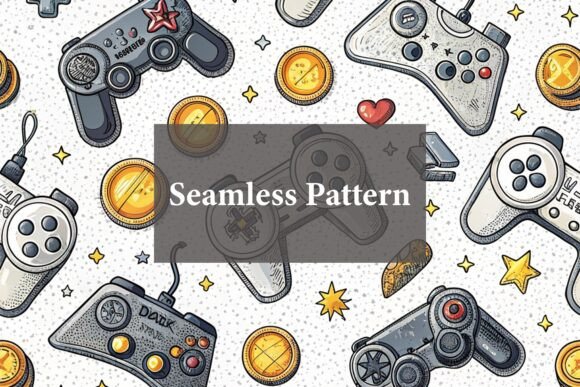
How to Evaluate the Retro Arcade Pixel Icons Pattern for Your Creative Projects
Design resources that capture a specific era without feeling derivative are rare. The Retro Arcade Pixel Icons Pattern is one such resource, offering a pixelated tile set that evokes the golden age of arcade gaming. This PNG file, sized at 12x12 inches at 300 DPI, delivers a crisp, scalable design that can be used in backgrounds, textile prints, digital mockups, and more. But before you commit to using it, it helps to understand what this pattern actually offers, how it compares to other retro-inspired design assets, and where it fits best.
What Defines the Retro Arcade Pixel Icons Pattern
At its core, this pattern is a seamless or repeating tile composed of pixel-style icons. The pixel art style deliberately references late 1970s through early 1990s arcade cabinets, where limited color palettes and blocky sprites defined the visual language. Unlike a vector illustration that might merely reference retro gaming, this pattern commits to the grid-based, low-resolution aesthetic that purists associate with titles like Pac-Man, Space Invaders, or early platformers.
The file itself is a PNG raster image. Because it is rendered at 300 DPI, the pattern remains sharp when printed at its native size or scaled down. The 12x12 inch format gives you a versatile canvas: you can tile it across a larger area, crop a section for a focused design, or use it as a standalone element on merchandise or packaging. The pixel density is high enough that the iconic jagged edges appear intentional and crisp rather than blurry or aliased.
What makes this pattern distinct from a generic pixel texture is the thoughtful iconography. The design includes recognizable arcade motifs: joysticks, buttons, coin slots, control panels, and possibly ghost or spaceship references. These icons are not random; they form a cohesive visual vocabulary that feels authentic rather than tacked on.
Comparing the Pattern with Alternative Retro Design Resources
When you are evaluating a retro arcade pattern, you are likely weighing several categories of design assets. Understanding the tradeoffs between them helps you decide whether this specific pattern meets your needs.
Raster Pixel Art versus Vector Illustrations
Many retro-themed patterns are created as vector files. Vectors offer infinite scalability and easy recoloring, which makes them popular for branding and large-format printing. The Retro Arcade Pixel Icons Pattern, however, is a raster PNG. This means it does not scale up beyond a certain point without losing quality. That limitation matters if you plan to use the pattern on a billboard or a wide-format banner.
On the other hand, raster pixel art often feels more authentic for a retro gaming theme. Because true pixel art is inherently resolution-dependent, a vector that mimics pixelation can look too smooth or artificial. The PNG format preserves the original pixel grid exactly as the designer intended, so each icon has a deliberate blocky shape. For small to medium projects—flyers, stickers, social media graphics, t-shirts, or website backgrounds—the raster format is not a drawback. For large-scale applications, you may need to source a vector alternative or request a larger file variant.
Seamless Repeating Patterns versus Single Illustrations
Single retro gaming illustrations are abundant online. You can find high-quality pixel art of characters or logos that stand alone. A repeating pattern like this one, however, is designed for tiling. That makes it inherently better suited for backgrounds, wrapping paper, fabric prints, or album covers where you need continuous coverage. The tradeoff is that a pattern cannot be easily isolated into individual icons without cropping, so if you need standalone icon assets, a dedicated icon set would be more practical.
If your project demands both a background pattern and individual icons, you may end up using the Retro Arcade Pixel Icons Pattern as the backdrop and supplementing it with separate icon files. Many designers find this combination effective for themed events, gaming cafes, or retro-branded merchandise.
High-Resolution Stock Textures versus Curated Design Packs
Stock texture sites offer pixel-style backgrounds that are often generic. They may use a simple grid pattern or a random arrangement of colored squares. These are cheap or free, but they lack the intentional iconography that makes the Retro Arcade Pixel Icons Pattern feel curated. If you want a pattern that tells a story—a visual tribute to the arcade experience—a curated pack is almost always a better choice. The tradeoff is cost and specificity. A generic texture may work for an abstract background, while this pattern makes a stronger statement about theme and era.
Strengths of the Retro Arcade Pixel Icons Pattern
For many use cases, this pattern offers a balance of quality and convenience that is hard to beat.
- Authenticity of style: The pixel art follows genuine retro constraints, so it resonates with audiences who grew up in the arcade era. It does not feel like a modern artist's approximation.
- Print readiness: At 300 DPI and 12x12 inches, the file is ready for home or commercial printing. You can use it for small runs of posters, postcards, or invitations without additional resizing.
- Versatile format: PNG supports transparency, so the pattern can be layered over solid backgrounds or other images. That is a significant advantage over JPEG-based textures that force a white or black background.
- Immediate usability: Unlike layered PSD files or AI vectors that require software familiarity, a PNG can be opened in any image viewer, dropped into design tools, and used instantly. This lowers the barrier for non-designers who need a quick retro look.
Limitations and When You Might Need Another Option
No single resource fits every project. Recognizing the limits of the Retro Arcade Pixel Icons Pattern helps you avoid frustration.
Scalability constraints: Because it is a raster file, enlarging the pattern beyond its native resolution will introduce pixelation beyond the intended aesthetic. If your project requires a giant wall graphic or a building wrap, you will need a vector-based alternative or a custom high-resolution version.
Customization difficulty: Changing individual icon colors or swapping elements requires pixel-level editing software like Photoshop or Aseprite. If you lack such tools or skills, you may find it easier to work with a vector pattern that can be recolored with a single click.
Thematic narrowness: The arcade theme is specific. It works wonderfully for gaming events, retro parties, tech nostalgia, or vintage-branded cafes. However, it may clash with modern minimalist branding, corporate presentations, or projects that require a subtle background pattern. In those cases, a more abstract or neutral option would serve you better.
Limited asset count: This is a single pattern file. It does not include a library of separate icon files, alternative colorways, or accompanying textures. If you need a complete design system with multiple matching patterns and assets, you may need to look for a larger pattern pack or bundle.
Decision Factors to Consider
Before you integrate the Retro Arcade Pixel Icons Pattern into your workflow, ask yourself a few practical questions.
- What is the output medium? If you are designing for print at a relatively small scale—T-shirts, stickers, flyers, cards, box packaging—the pattern is an excellent match. If you need digital backgrounds for a website or app, the pattern works well under 150 DPI settings, but test it at actual size first.
- What is your audience's relationship with retro gaming? Adults aged 20 to 50 who grew up with arcade games will recognize and appreciate the iconography. For a younger or less nostalgic audience, the pattern might feel dated or niche. Understand your demographic's emotional connection to the era.
- Do you need to modify the design? If you anticipate changing colors or rearranging icons, factor in the time and tools required. If you are comfortable editing PNGs, the pattern is flexible. If you want a plug-and-play solution, it still works, but only as-is.
- How does the pattern fit with your existing brand assets? The high-contrast, saturated color palette common in arcade patterns may require careful pairing with logos or typography. Neutral backgrounds or monochrome brand elements often balance the pattern well.
Realistic Example Scenarios
Imagine you are designing a limited-run sticker sheet for a retro gaming convention. The stickers need to feel authentic, and you want a cohesive background pattern behind the cut-out designs. Using the Retro Arcade Pixel Icons Pattern as the backing texture gives the sheet an immediate arcade feel without adding extra illustration time. In this case, the PNG format and print-ready resolution are clear advantages.
Now consider a client who wants a full wall mural for a game lounge, covering an area of eight feet by ten feet. The same pattern, when scaled up, will lose crispness because there is not enough pixel data to fill that space cleanly. Here, you would either need to source a vector pattern or create a larger custom pixel texture to avoid blurry edges.
Another scenario: You are building a WordPress site for a vintage arcade bar. You want a subtle, repeating background that does not distract from content. The Retro Arcade Pixel Icons Pattern, placed in the footer or behind a semi-transparent overlay, can add atmosphere without overwhelming the interface. Because it is a PNG with transparency, you can adjust opacity in your CSS or design tool, making it a flexible choice for digital use.
Final Perspective on Fit
The Retro Arcade Pixel Icons Pattern is a well-executed design asset for anyone who needs an authentic, printed, or digital background with genuine retro gaming character. Its 12x12 inch 300 DPI format gives you immediate print readiness, and the pixel aesthetic is faithful to the source material in a way that vector approximations rarely match.
Still, no pattern is universal. If your project demands infinite scaling, easy recoloring, or a broader asset set, you will need to complement this resource with other tools. The key is to match the pattern's strengths to your project's specific requirements. For many small- to medium-scale projects that center on arcade nostalgia, this pattern is a practical and visually compelling choice that saves preparation time while delivering on theme.