Pan American Aviation Day Puzzles for Young Explorers
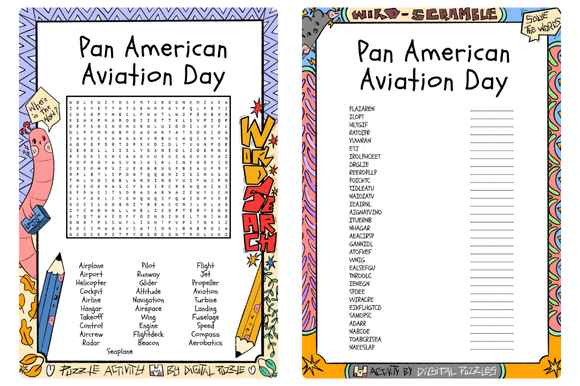
Every December 17th, Pan American Aviation Day offers a perfect opportunity to introduce children to the wonders of flight. But turning a historical observance into a meaningful learning experience for second through fifth graders can be tricky. Young minds need engagement, not just facts. That is where Pan American Aviation Day Puzzles come in. These themed word search and scramble worksheets transform aviation vocabulary into an interactive challenge, making the learning process feel like play. Designed specifically for elementary students, these puzzles come complete with answer keys, so educators and parents can focus on teaching rather than solving.
What Makes These Puzzles a Practical Classroom Tool
At their core, Pan American Aviation Day Puzzles are printable worksheets built around aviation-themed terms. A word search asks students to locate hidden words like "propeller," "altitude," or "cockpit" within a grid of letters. A word scramble presents jumbled combinations such as "nileng" for "engine" or "pilot" rearranged into "litop," challenging students to decode the correct term. Both formats reinforce spelling, pattern recognition, and contextual understanding in a low-pressure, enjoyable setting.
The real value for educators lies in the dual benefit these puzzles offer. Children naturally want to complete challenges, and each solved word or found term builds confidence. At the same time, the vocabulary becomes familiar through repetition and active recall. A student who unscrambles "runway" is far more likely to remember that term than one who simply reads it from a list. This passive-to-active shift is exactly what makes Pan American Aviation Day Puzzles effective for young learners.
Supporting Cognitive Growth Through Thematic Play
Cognitive development in elementary years thrives on pattern recognition, working memory, and problem-solving. Word searches require visual scanning and attention to detail. Word scrambles demand letter sequencing and mental flexibility. When these activities are wrapped in an aviation theme, students are not just practicing generic skills; they are building domain-specific knowledge. They learn that "fuselage" is the main body of an aircraft, that "aviation" refers to the operation of aircraft, and that "Pan American" connects to a historic airline that pioneered international routes. The puzzles become a gateway to broader understanding.
What is more, the included answer keys allow for independent checking. Students can self-correct, which fosters autonomous learning habits. For the teacher or parent, this means less time grading and more time discussing the fascinating stories behind the words. You might ask a child who just found "hangar" to describe what happens inside one, turning a puzzle moment into a mini-lesson.
Why Educators and Parents Are Turning to Puzzle-Based Learning
The traditional worksheet can feel like a chore. But Pan American Aviation Day Puzzles flip that expectation. When students see a word search or scramble, their natural curiosity kicks in. They want to be the first to find all the terms or unscramble every jumble. This intrinsic motivation is exactly what educators want to cultivate. Instead of forcing vocabulary memorization, you are inviting students to discover it on their own terms.
Another reason these puzzles work is their adaptability. A second grader might need help sounding out longer words like "biplane," while a fifth grader can handle terms such "navigation" or "transatlantic." The same set of puzzles can be used across a range of abilities by offering hints or pairing students strategically. You can also use them as a warm-up activity, a transition between lessons, or a calm-down exercise after recess. The flexibility is built into the format.
Realistic Use Cases in the Classroom and at Home
Imagine you are a third-grade teacher planning a unit on transportation. On Pan American Aviation Day, you hand out a word search that includes "airmail," "pilot," and "runway." Students work individually for ten minutes, then you review the answers together, asking volunteers to share what each word means. A child who found "airmail" might ask if people still send letters by plane, sparking a conversation about how aviation changed communication. The puzzle is not just an activity; it is a discussion starter.
For a homeschooling parent, the scramble worksheets can serve as a spelling review. You give your fourth grader a list of scrambled aviation terms. As they work through "tomno" (moton? no, "motor") and "irafctr" (aircraft), they are practicing letter order and sounding out syllables. After finishing, you watch a short video about the history of Pan American World Airways. The puzzle primes their brain for the lesson that follows.
Even in after-school programs or library events, these puzzles shine. Set up a station with several copies, and let children choose between the word search or the scramble. Some will prefer the quiet focus of scanning a grid, while others enjoy the mental gymnastics of unscrambling. The variety ensures that different learning styles are accommodated without extra planning on your part.
Key Considerations Before Using the Puzzles
While Pan American Aviation Day Puzzles are user-friendly, a few practical points can help you get the most out of them. First, consider the reading level of your students. The worksheets are tailored for second through fifth grade, but individual reading abilities vary. Preview the vocabulary list to ensure the terms match your group. If a child struggles with longer words, you can pair them with a buddy or provide a small word bank for reference.
Second, decide how you will introduce the theme. A brief discussion about Pan American Aviation Day can set context. You might explain that this day honors the first regularly scheduled international airline flights and celebrates advances in aviation. When students understand that the words they are searching for connect to real history, the activity gains depth. You could also display a map showing Pan American routes, linking geography to vocabulary.
Third, think about timing. Word searches typically take ten to fifteen minutes for elementary students, while scrambles might take a bit longer depending on the number of terms. Plan for a short follow-up activity, such as writing a sentence using three of the words or drawing a picture of an airplane and labeling its parts. This extends the learning beyond the puzzle itself.
How Thematic Vocabulary Prediction Skills Take Flight
One of the most rewarding outcomes of using these puzzles is watching students develop prediction skills. When faced with a scrambled word like "nwdiw" (window), a child must mentally test letter combinations. They might try "windo" before landing on the correct spelling. This trial-and-error process strengthens neural pathways associated with language and problem-solving. Similarly, searching a word grid trains the eye to anticipate where letters might appear, improving visual scanning speed.
These skills transfer to other subjects. A student who becomes skilled at unscrambling aviation terms will approach spelling challenges in science or social studies with the same strategic mindset. The puzzles, in effect, become a workout for the brain, and the aviation theme keeps the workout interesting. You are not just teaching words; you are teaching how to approach unfamiliar information with confidence.
Practical Tips for Integrating the Puzzles into Your Curriculum
If you are a classroom teacher, consider using the puzzles as part of a broader aviation mini-unit. Pair the word search with a reading passage about the Wright brothers or Amelia Earhart. Use the scramble worksheet as a review game before a quiz. You can even create a friendly competition: who can finish the word search fastest with all words found correctly? The key is to keep the atmosphere positive and focused on exploration rather than speed.
For parents working with children at home, the puzzles can be a weekend activity that feels like a game. Print a set, grab some pencils, and sit together at the kitchen table. Let your child take the lead while you offer encouragement. If they get stuck on a scrambled word, give them the first letter as a hint. Celebrate each success, no matter how small. The goal is to build positive associations with learning.
Librarians and youth group leaders can also benefit. Set up a Pan American Aviation Day display with books about flight, model airplanes, and a stack of puzzle worksheets. Children can take one home or complete it on-site. This passive offering still delivers educational value and aligns with the observance without requiring a full program.
Fostering a Balance Between Education and Entertainment
The beauty of Pan American Aviation Day Puzzles is that they never feel like drudgery. The child is entertained by the challenge, while the adult knows that meaningful learning is happening. This balance is not easy to achieve in elementary education. Worksheets that are too academic risk losing attention, while activities that are only fun can waste instructional time. These puzzles sit squarely in the sweet spot: engaging enough to hold interest, structured enough to deliver content.
When a child exclaims, "I found 'propeller'!" there is genuine excitement. That excitement is the engine of deeper learning. It opens the door to questions: Why do planes have propellers? How do they work? What is the difference between a propeller and a jet engine? The puzzle did not answer those questions, but it created a reason to ask them. As an educator or parent, you now have a naturally curious audience ready to learn more.
Getting Started with Pan American Aviation Day Puzzles
To begin, simply obtain a set of the worksheets designed for your students' grade range. Print enough copies for everyone, and gather pencils or highlighters for the word search. For the scramble, a pencil and eraser are helpful, as children may want to try different letter orders. Explain the activity briefly, then let them dive in. Circulate to offer support, but resist the urge to solve puzzles for them. The learning happens in the struggle.
After the puzzles are complete, review the answers as a group. Ask which word was hardest to find or unscramble, and discuss why. This reflection reinforces the vocabulary and gives you insight into which terms need more explanation. You might notice that "fuselage" appeared difficult for several students, so you could elaborate on its meaning with a diagram. The puzzles reveal knowledge gaps in a low-stakes way, allowing you to address them naturally.
Pan American Aviation Day Puzzles are more than just worksheets. They are a gateway to aviation history, a tool for cognitive development, and a source of genuine enjoyment for young learners. By incorporating them into your curriculum or home routine, you honor a historic day while giving students a reason to love learning about flight. And when a child proudly announces that they know what "aviation" means, you will know your approach is working.