Building Immersive Digital Experiences with the 50 Games Entertainment Line Icons Collection
In the rapidly evolving landscape of digital media, the visual language we choose directly shapes how audiences perceive and engage with content. Whether you are a game developer polishing a user interface, a streaming platform designer crafting a seamless viewer experience, or an educator creating interactive learning materials, the quality and cohesion of your graphic assets can make or break a project. The 50 Games Entertainment Line Icons set emerges as a versatile tool designed to address these exact needs—bridging the gap between functional design and expressive storytelling through a library of modern, scalable vector icons.
Decoding the Icon Set: From Controllers to Popcorn
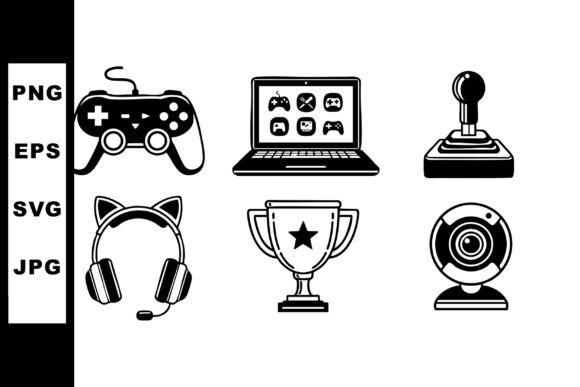
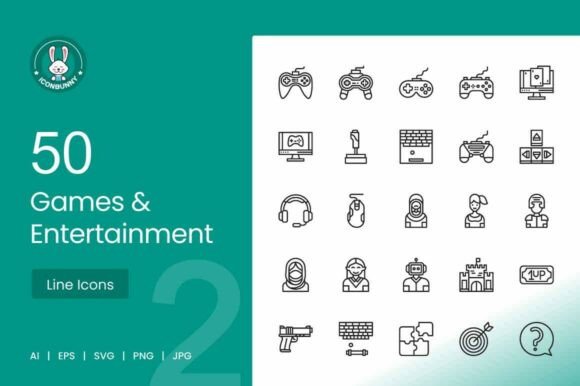
At its core, this collection is more than a simple assortment of graphics. It represents a curated library of 50 distinct symbols that cover the full spectrum of gaming and entertainment culture. The icons span from essential hardware—game controllers, consoles, joysticks, and gaming computers—to peripheral experiences like VR headsets, dice, cards, trophies, movie reels, music notes, popcorn, and tickets. Each icon is crafted with a clean, modern line art style that ensures consistency across the entire set. This uniformity is critical when building interfaces where visual harmony directly impacts usability and brand recognition.
The fully editable and scalable nature of the 50 Games Entertainment Line Icons assets means that designers are not locked into a fixed aesthetic. The vector format allows for infinite resizing without loss of quality—from a 16px tooltip icon to a 1024px hero graphic. The well-organized layers within each file further streamline the customization process, enabling rapid color changes, stroke adjustments, or combination with other design elements. For professionals working across platforms like Illustrator, Canva, Figma, or Sketch, this interoperability reduces friction and accelerates workflow.
Game Developers and Interactive Studios
For indie studios and large development teams alike, iconography plays a pivotal role in user experience. In-game menus, inventory screens, settings panels, and achievement displays all rely on immediately recognizable symbols. The inclusion of trophies, dice, cards, and VR headsets in the 50 Games Entertainment Line Icons collection directly supports these use cases. A trophy icon can denote player achievements, while a dice symbol fits naturally into turn-based strategy or role-playing game interfaces. The line style also integrates well with both minimalist and detailed UI themes, offering flexibility without clashing with the game’s art direction.
Entertainment Brands and Streaming Services
Streaming platforms, media blogs, and entertainment brands require a visual vocabulary that communicates instantly. Movie reels, music notes, popcorn, and tickets are universal symbols that need no explanation. Using this icon set, a streaming service can build a categorized library interface—where the reel icon leads to film content, the music note opens audio experiences, and the ticket stands for live events or premium access. The consistent line weight and stroke style across all 50 icons ensure that even when used across different pages or devices, the experience feels unified and professional.
Educators and Content Creators
Educational content, especially in game design, media studies, or digital arts, benefits greatly from clear visual aids. Teachers and course creators can integrate the 50 Games Entertainment Line Icons into presentations, worksheets, or online learning modules. For instance, a lesson on the history of video games could use the controller, console, and joystick icons to illustrate different eras of hardware. Similarly, a media literacy module might employ the movie reel and ticket icons to discuss film distribution. The icons serve as non-distracting, professional illustrations that reinforce learning objectives without competing for attention.
Social Media Campaigns and Marketing Assets
Social media managers and marketing professionals often need to produce engaging visuals under tight deadlines. The ready-to-use SVG and PNG formats included in the 50 Games Entertainment Line Icons set allow for quick deployment in posts, ads, or banner graphics. The 1024×1024 pixel size at 72 DPI provides sufficient resolution for most digital platforms, while the vector files offer the option to scale up for larger print materials like posters or event signage. The modern line style also aligns well with current design trends, making content feel fresh and contemporary.
Technical Versatility and File Format Considerations
A significant advantage of this icon collection lies in the breadth of included file formats. The package delivers 50 AI, 50 EPS, 50 SVG, 50 PNG, and 50 JPG files—each format serving a distinct purpose:
- AI and EPS: These industry-standard vector formats are ideal for deep customization in Adobe Illustrator or similar vector editors. Layers remain intact, allowing designers to toggle visibility, recolor individual elements, or merge icons with other vector assets.
- SVG: For web developers and UI designers, SVG files offer the best balance of scalability and performance. They can be embedded directly into HTML, styled with CSS, and animated with JavaScript, making them perfect for interactive prototypes or live websites.
- PNG and JPG: Raster formats are essential for quick mockups, social media graphics, or environments where vector support is limited. The 1024×1024 resolution ensures clean renders at standard display sizes, and the transparent PNG backgrounds simplify compositing in any design software.
This multi-format approach ensures that no matter the project pipeline—whether it involves print, web, mobile app, or presentation software—the 50 Games Entertainment Line Icons can be incorporated without conversion headaches.
Design Trends and the Role of Consistent Iconography
Modern user interfaces are moving toward cleaner, more inclusive visual languages. The line icon style, with its uniform stroke widths and simplified forms, fits squarely within this movement. Unlike filled or heavily detailed icons, line icons communicate with minimal visual noise, reducing cognitive load for users. This is particularly important in entertainment and gaming contexts where speed of recognition can enhance gameplay flow or browsing efficiency.
Moreover, the set’s coverage of both gaming-specific items (joysticks, consoles, VR headsets) and broader entertainment symbols (music notes, popcorn, tickets) enables a cohesive visual narrative across diverse content types. A gaming blog, for instance, can use the same icon language for its navigation menu, article headers, and social media teasers. This consistency builds brand recognition and trust—a subtle but powerful advantage in crowded digital spaces.
Integration into Workflow and Design Systems
For teams already using design systems or component libraries, the 50 Games Entertainment Line Icons can be integrated as a shared asset. Because the icons are fully editable, designers can adjust stroke weights to match existing UI guidelines, change colors to align with brand palettes, or combine multiple icons to create new composite symbols. The 72 DPI resolution standard is appropriate for screen-based work, and the 1024×1024 canvas provides ample room for detail when needed.
When adding these icons to a Figma or Sketch library, the SVG and AI formats maintain their editability. Designers can convert strokes to outlines, apply gradients, or nest icons within component variants. This flexibility reduces the need for custom icon requests, freeing up time for higher-level design thinking. For solo developers or small teams, the ready-to-use nature of the set means that even without dedicated design resources, projects can maintain a professional visual standard.
Considerations for Effective Use
While the 50 Games Entertainment Line Icons collection is extensive, its real power is unlocked through intentional application. Here are a few observations that can guide effective usage:
- Contextual relevance: Not every icon fits every scenario. For a mobile game targeting casual users, the trophy and dice icons might be front and center, while the VR headset might be reserved for settings or advanced features. Mapping icons to user journeys ensures they serve wayfinding, not just decoration.
- Accessibility: Line icons, particularly at smaller sizes, can lose clarity if stroke weights are too thin. When using these assets in UI, consider pairing them with text labels or tooltips, especially for less universally recognized symbols. The clean design of this set does help, but testing at target display sizes is always recommended.
- Brand alignment: The neutral line style acts as a blank canvas. Brands with bold color schemes can apply their primary palette to the icons, while those favoring monochrome aesthetics can rely on the pure stroke forms. The organized layers make such mass recolor fast and consistent.
- File management: With 250 files delivered (50 per format), maintaining a clean asset library is important. Naming conventions and folder structures should be established early to prevent clutter. The included formats are well-suited for different stages of production—SVGs for prototyping, AI/EPS for master editing, PNG/JPG for final exports.
Observations on the Evolving Role of Icon Assets
In recent years, the expectation for high-quality, ready-to-use design assets has risen sharply. As more creators enter the gaming and entertainment space—through platforms like Twitch, YouTube, itch.io, or Steam—the barrier to entry for content creation has lowered, but the demand for visual polish has only increased. The 50 Games Entertainment Line Icons set addresses this gap by offering a professional-grade resource that does not require an advanced design background to utilize effectively.
The set also reflects a broader industry shift toward modular, reusable design components. Instead of commissioning custom icons for every new project, designers and developers can draw from a consistent library, ensuring that a sports title, a puzzle game, and a media streaming app all share a visual family tree when needed. This approach not only saves time and money but also strengthens the overall ecosystem of a brand or product suite.
Furthermore, the inclusion of entertainment-adjacent icons—such as movie reels and popcorn—acknowledges that the boundaries between gaming and other media are increasingly blurred. A modern game might include cinematic cutscenes, a streaming platform might host interactive live events, and a social media campaign might blend gameplay clips with music and film references. Having a unified icon language across these touchpoints helps audiences navigate seamlessly between experiences.
Concluding Perspective on Asset-Driven Design
The ultimate value of the 50 Games Entertainment Line Icons lies not just in the number of icons, but in the thoughtfulness of their design and the breadth of their application. They serve as building blocks for visual communication—whether in a AAA game UI, an indie developer’s itch.io storefront, a university course on interactive media, or a streaming platform’s mobile app. The combination of modern aesthetics, full editability, and multi-format support positions this collection as a practical asset for anyone invested in creating engaging, user-friendly digital experiences.
As you evaluate icon sets for your own work, consider not only the visual style but the underlying structure: how well do the icons scale? Can they be adapted without friction? Do they cover the specific symbols your audience will recognize? The 50 Games Entertainment Line Icons answers these questions with a collection that is both comprehensive and adaptable, ready to be dropped into existing workflows or to inspire entirely new visual systems. Whether you are building a game interface, designing a streaming portal, or crafting educational content, these icons provide a reliable foundation upon which to build memorable, interactive experiences.