The Distinctive Appeal of Black and White Dice in Vector Illustration
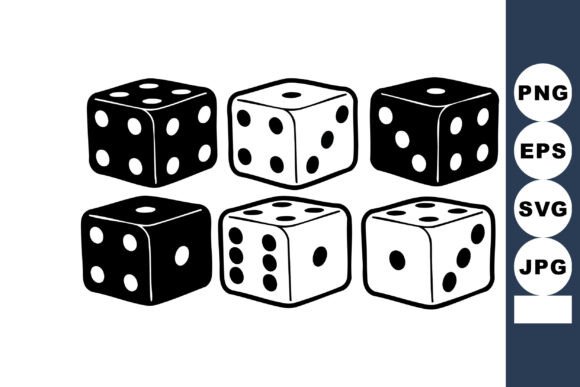
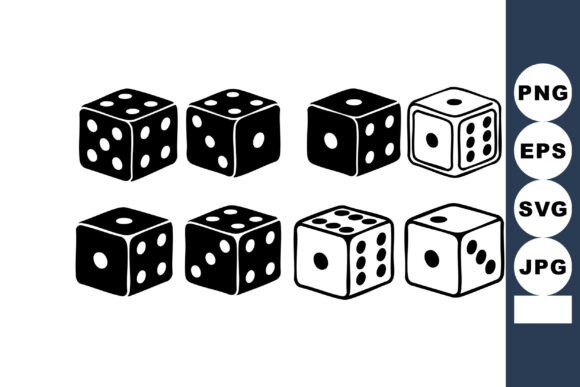
Dice are among the most universally recognized symbols of chance, decision-making, and games of all kinds. When rendered in black and white, these simple cubic forms take on a refined visual identity that strips away distraction and focuses attention on pattern, number, and composition. The specific illustration of eight dice, arranged neatly in two rows with varying pip configurations, offers a compelling study in contrast, balance, and readability. This particular vector style, clean and minimal, invites viewers to appreciate the geometry of luck without the noise of color. Whether used in branding, educational materials, game design, or editorial content, such imagery carries a calm authority that resonates across many contexts.
The phrase "Of Black and White Dice Showing Difference" naturally suggests variation within uniformity. Each die in the two-row arrangement displays a unique pip pattern, yet the monochrome palette unifies them into a cohesive whole. This tension between sameness and distinction is precisely what makes dice imagery so versatile. Designers and content creators often seek assets that communicate both structure and possibility, and black and white dice deliver exactly that. The downloadable ZIP containing SVG, EPS, JPG, and PNG files ensures that whether the project is destined for screen, print, or further editing, the asset is ready to deploy without compromise.
Design Characteristics That Define the Eight-Dice Arrangement
The eight dice are not randomly scattered; they are deliberately positioned in two rows of four. This arrangement creates a sense of order and predictability, which contrasts nicely with the inherent randomness of the pips themselves. In the illustration, each die face shows a different number of dots, ranging from one to six, with some likely repeating across the set. The black pips against white dice, or white pips against black dice, produce a stark visual clarity that is easy to process at a glance. This is especially valuable in contexts where quick recognition matters, such as infographics, game rule explanations, or instructional diagrams.
The vector nature of the illustration means that every line, circle, and square is mathematically precise. There is no pixelation, no blurring, and no loss of quality when scaling. The clean style further enhances the minimalist aesthetic by eliminating gradients, shadows, and textures that might clutter the composition. Instead, the focus remains squarely on the dice themselves and the patterns they display. This approach aligns with contemporary design trends that favor flat, accessible visuals over ornate decoration. The calm mood mentioned in the description is achieved through this restraint, making the image suitable for applications where a serene or focused atmosphere is desired.
Practical Applications Across Creative and Professional Fields
Black and white dice illustrations find their way into an impressive range of projects. Game designers, both digital and tabletop, incorporate such assets into rulebooks, box covers, and interface elements. The eight-dice arrangement can serve as a background pattern, a loading screen graphic, or a thematic divider between sections of a gaming manual. Educators and researchers working with probability, statistics, or game theory use dice imagery to illustrate concepts like random distribution, expected value, and combinatorial outcomes. The black and white palette makes the visuals suitable for academic publications where color printing may be restricted or costly.
Content creators and marketers often turn to dice graphics when producing materials related to risk, strategy, or decision-making. A blog post about financial planning, a video thumbnail about career choices, or a social media graphic about life’s uncertainties can all benefit from the immediate cultural association of dice with chance. The clean vector style ensures that the image reproduces well across platforms, from high-resolution monitors to small mobile screens. Business owners who produce training materials, workshop slides, or team-building resources may find that dice imagery adds a touch of playfulness without sacrificing professionalism.
Hobbyists and crafters also value these assets. Printable dice designs can be used in scrapbooking, card making, or custom board game projects. The availability of JPG and PNG files allows for easy import into word processors or simple design software, while SVG and EPS formats cater to those who need to edit colors, resize elements, or combine the dice with other graphics. The inclusion of both raster and vector formats means that users at any skill level can work with the illustration, regardless of their software environment.
The Technical Advantage of Multi-Format Vector Assets
A downloadable ZIP containing SVG, EPS, JPG, and PNG files is more than a convenience; it is a strategic resource. SVG and EPS are vector formats that preserve the infinite scalability of the design. Whether a user needs a die face to fill a billboard or to appear as a tiny icon in a mobile app, the image remains crisp and sharp. These formats also allow for easy editing in programs such as Adobe Illustrator, Inkscape, or CorelDRAW. A designer can change the orientation of a die, modify the size of the pips, or invert the black and white scheme with just a few clicks.
JPG and PNG files serve users who need ready-to-use raster images. PNG offers lossless compression and supports transparency, which is ideal for layering dice over backgrounds in presentations or websites. JPG provides a smaller file size suitable for quick sharing or for use in environments where file size constraints exist. Having all four formats in a single ZIP means that the illustration can be adapted for any workflow without requiring conversion or quality loss. This flexibility is especially important for professionals who work across multiple projects with varying technical requirements.
Why Black and White Dice Resonate with Audiences
The cultural weight of dice extends far beyond gaming. They are metaphors for fate, luck, and the unknown. When presented in black and white, dice take on an additional layer of meaning: the binary nature of black and white mirrors the binary nature of many decisions, yes or no, win or lose, continue or stop. This duality makes the imagery resonate on a subconscious level with viewers. The clean vector style removes any ambiguity about the subject, presenting dice as archetypal symbols rather than as specific objects from a particular game.
Furthermore, the arrangement of eight dice in two rows creates a visual rhythm that is both balanced and dynamic. The eyes can scan across the rows, comparing pip counts, noticing patterns, and instinctively looking for sequences or pairs. This natural engagement with the image keeps viewers interested longer than a more complex or cluttered design might. In an age of information overload, minimal visuals that invite contemplation are increasingly rare and valued. The calm mood of this illustration provides a moment of visual rest, which can be strategically placed in documents or interfaces that are otherwise dense with text or bright colors.
Integrating Dice Imagery into Digital and Print Projects
For web designers, the SVG format is particularly attractive because it can be styled with CSS, animated with JavaScript, or embedded directly into HTML without external file dependencies. A dice illustration could become the basis for an interactive element, such as a random number generator or a game simulation. The PNG version with transparency can be used as a watermark or a subtle background motif on a blog or portfolio site. Print designers benefit from the EPS format, which is standard in professional publishing workflows and ensures compatibility with high-end printing systems.
When using the black and white dice in educational materials, instructors can enlarge specific dice to highlight particular pip counts, or they can print the entire eight-die grid as a handout for students learning probability. The absence of color means that photocopies retain the full impact of the original design. In board game prototyping, the vector files allow for rapid iteration: a designer can adjust the size, arrangement, or contrast of the dice to test different visual hierarchies. The availability of both black-on-white and white-on-black variations within the same illustration further expands the range of potential uses.
Observations from real-world usage show that such assets are frequently employed in annual reports, strategic planning documents, and workshop materials where the theme of chance or risk is relevant. A company discussing market uncertainty might use a single die as a section header, or a nonprofit explaining the odds of a fundraising goal might incorporate the full eight-dice grid as a visual metaphor. The calm and minimal design supports the seriousness of these contexts without introducing frivolity. It communicates that while outcomes may be uncertain, the process can be approached with clarity and composure.
Observations on the Calm Mood Achieved Through Minimal Design
The deliberate reduction of visual elements in the black and white dice illustration contributes significantly to its calm mood. There are no competing colors, no decorative flourishes, and no background distractions. The eye rests on the dice themselves, which are presented with geometrical precision. The spacing between the dice in the two rows is consistent, creating a grid-like order that the brain finds reassuring. Even the varying pips, which introduce an element of randomness, are arranged within the strict boundaries of each die face. This combination of order and variation mirrors the way people approach games of chance: with an understanding that outcomes are uncertain, but the framework is known.
Users who download the ZIP file gain access to a resource that respects the viewer's attention. In a world where many visuals compete through brightness, motion, and complexity, the restraint of black and white vector art stands out. It signals confidence in the subject matter and respect for the audience's ability to engage with subtlety. Whether applied in a classroom handout, a corporate slide deck, a game prototype, or an artistic project, these dice carry a quiet authority that enhances the message they accompany. The very lack of color becomes a statement in itself, saying that what matters here is shape, pattern, and meaning, not decoration.
Ultimately, the value of "Of Black and White Dice Showing Difference" lies in its versatility and its timeless aesthetic. The eight dice in two rows capture the essence of chance while maintaining a composed and measured tone. For creators, educators, business owners, and hobbyists alike, this illustration offers a ready-to-use visual that communicates complex ideas with elegant simplicity. The availability of four file formats ensures that no matter the project, the asset can be integrated smoothly and effectively. In a crowded visual landscape, black and white dice remind us that sometimes the most powerful images are the simplest ones.